International Trade

New AD Case Filed Against Polytetramethylene Ether Glycol From China, South Korea, Taiwan, and Vietnam   

A new antidumping action has been filed against Polytetramethylene Ether Glycol from China, South Korea, Taiwan, and Vietnam. The allegation is that imports from China, South Korea, Taiwan, and Vietnam are being dumped.  

Full list of exporters here

Import volume here.  

Background on AD Investigations 

Antidumping duty (“AD”) is brought jointly by the U.S. International Trade Commission (“USITC”) and the U.S. Department of Commerce (“Commerce”). AD investigations are triggered when a domestic industry alleges that it has been injured by competing imports of particular goods from specific countries being sold at less than a fair value. The domestic industry initiating the investigation is known as the petitioner, while the foreign industry participating in the investigation is known as the respondent. 

Scope of the Investigation 

The merchandise covered by these investigations is all forms of polytetramethylene ether glycol (“PTMEG”).  

The products subject to the investigation are currently classified in the Harmonized Tariff Schedule of the United States (HTSUS) under the following subheadings: 3907.29.00 and 2932.11.00.   

Full scope here.

Next Steps 

The Commerce Department will determine whether to initiate the investigations within 20 days. The USITC will reach a preliminary determination of material injury or threat of material injury within 45 days. 

As with any proceeding, participation is very important to protect your rights. We urge anyone who imports Polytetramethylene Ether Glycol from China, South Korea, Taiwan, or Vietnam to […]
New OFAC Advisory: Signs of Sham Transactions and Sanctions Evasion

On March 31, 2026, the U.S. Department of the Treasury’s Office of Foreign Assets Control (OFAC) released an important advisory addressing the growing use of sham transactions to evade U.S. sanctions. The guidance highlights how sanctioned individuals and entities often attempt to disguise their continuing interest in property through opaque legal structures, proxies, and other intermediaries. OFAC’s message is clear: transactions that merely appear to transfer ownership but do not genuinely extinguish a blocked person’s interest remain prohibited. 

What OFAC Defines as a “Sham Transaction” 

Sham transactions occur when blocked persons “give up their property on paper only,” while continuing to benefit from or control the asset. These arrangements often involve: 

  • Proxies, straw owners, or front companies acting on behalf of sanctioned individuals. 
  • Opaque legal structures, including multi‑layered LLCs, partnerships, or trusts. 
  • Transfers to family members or close associates who may serve as facilitators. 
  • Commercially unreasonable transfers, such as those lacking adequate consideration. 
  • Continued use or control of the asset by the blocked person after the purported transfer. 

Pro Tip: Look beyond legal formalities and identify the economic realities of the transaction. 

Red Flags Identified by OFAC 

The advisory outlines several indicators that a transaction may be a sham designed to evade sanctions. These include: 

New Executive Order Adjusting Imports of Aluminum, Steel, and Copper into the United States

Authors:

Jennifer Diaz, President, Diaz Trade Law
Amber Pirson, Attorney, Diaz Trade Law

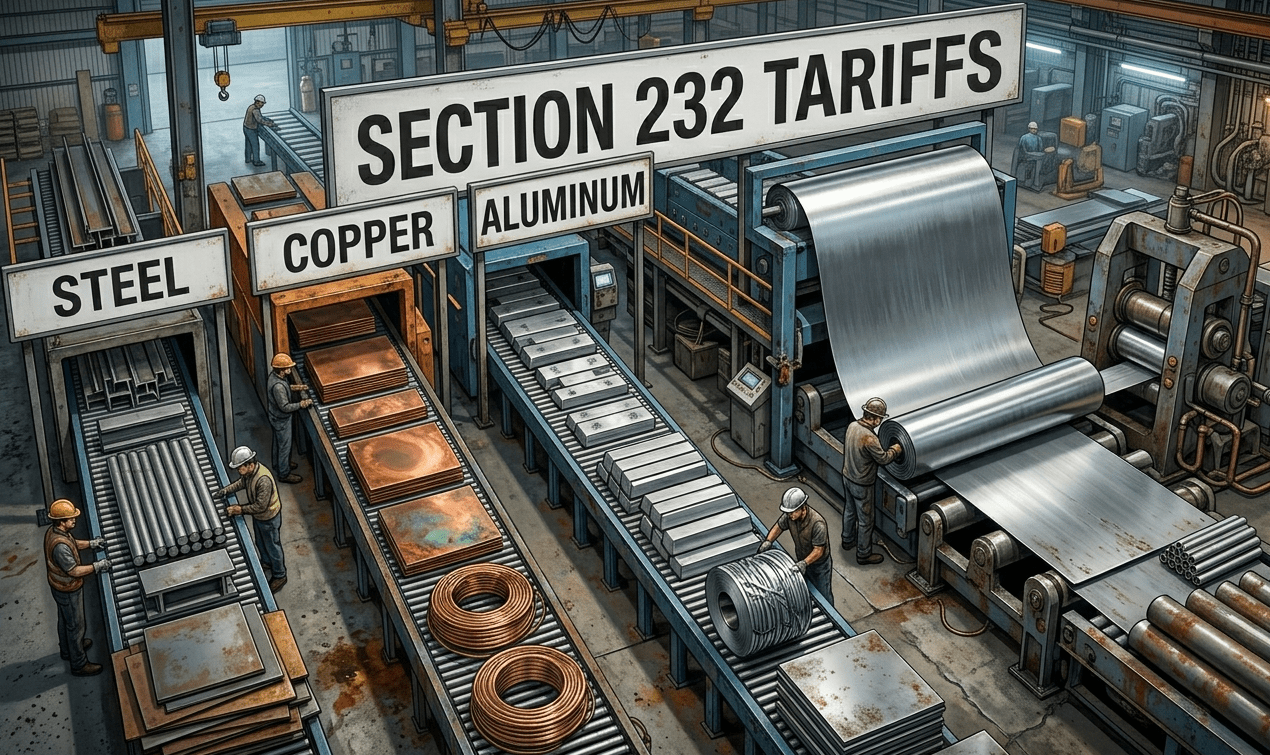
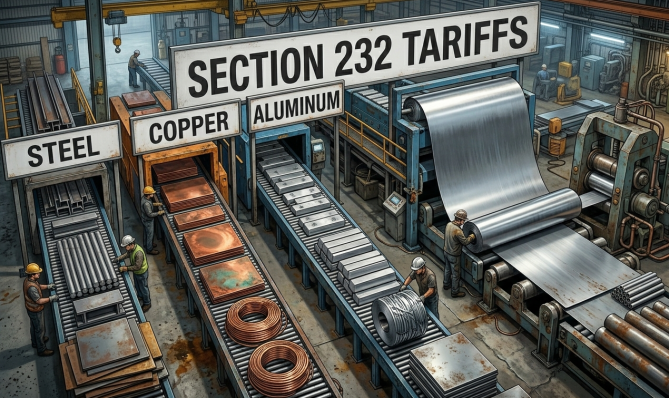
On April 2, 2026, the President issued a proclamation strengthening Section 232 actions to adjust imports of aluminum, steel, and copper, continuing to cite national security concerns and the need to reinforce domestic metals industries. 

Key elements include: a tiered tariff structure and some products exempt from Sec. 232 tariffs, effective at 12:01 am on April 6, 2026; and manufacturing drawback claims.  

Generally, tariffs will be assessed to the full value of imported products, “regardless of their metal content,” with reduced rates for certain products from the United Kingdom (UK) and the same 200% ad valorem duty for subject metal articles from Russia. 

  • Aluminum and steel articles, most copper articles, and certain derivative articles of aluminum and steel…  
    • 50%, unless either the 25% or 10% rates listed below can apply. 
      • 25% for UK products, the aluminum content of which is composed entirely of aluminum that was smelted or most recently cast in the UK, or the steel content of which is composed entirely of steel that was melted and poured in the UK. 
      • 10% for derivative articles, steel or copper content, when the metal content was smelted and cast in the U.S. 
  • For certain copper and […]

Court Orders Refunds of IEEPA Tariffs – NOW Is the Time to File Litigation at the CIT

In a significant development for importers, on March 4, 2026, Judge Eaton of the Court of International Trade (CIT) issued a strong and detailed order requiring the refunds for entries of every plaintiff before the CIT who has challenged these IEEPA Tariffs.

The CIT Order

In the order, Judge Eaton clearly stated that the court has jurisdiction under 28 U.S.C. § 1581(i), the CIT has national jurisdiction and the ability to issue a broad order, that he is the judge to whom all IEEPA refunds have been assigned, and that he views the facts and law as clear. It is not clear whether he is also ordering the refunds for everyone else not in court, which will unquestionably be further litigated. 

We note that in response to written questions from the court, U.S. Customs and Border Protection stated that they were continuing to liquidate entries with IEEPA duties if they were deposited at the time of entry, that they were not issuing refunds, and that they had not issued instructions to liquidate without IEEPA duties. They further stated that any refunds will require a review to determine if there was a violation of other customs laws or if other duties, taxes, and fees were still owed. In other words, CBP intends to conduct detailed reviews of all entries before issuing refunds. The responses provided by CBP to the Judge were reviewed by the Judge and likely resulted […]

Supreme Court Rules IEEPA Tariffs Are Unlawful

Today, the Supreme Court of the United States (SCOTUS) issued its opinion in Learning Resources, Inc., et al. v. Trump. The Court ruled that IEEPA does not authorize the president to impose tariffs. 

The Court rejected the Trump Administration’s assertion that the statutory text of IEEPA delegates Congressional tariff powers to the President, finding that Congress would not have delegated “highly consequential power” through ambiguous language.

The majority wrote, “Based on two words separated by 16 others in … IEEPA, ‘regulate’ and ‘importation’–the President asserts the independent power to impose tariffs on imports from any country, of any product, at any rate, for any amount of time. Those words cannot bear such weight.”

The decision was 6-3, with Justice Thomas, Alito, and Kavanaugh dissenting.

What This Means for Importers

The Trump Administration has made clear that, regardless of the Supreme Court’s decision, tariffs will remain a cornerstone of their trade and “America First” policy. 

On January 9, 2026, National Economic Council Director Kevin Hassett said of the Supreme Court case: “Our expectation is that we’re going to win, and if we don’t win, then we know that we’ve got other tools that we can use that get us to the same place.” He also said in a Fox Business Interview that the Administration has a backup plan ready to go that would allow tariffs to be put “back into […]

Go to Top