U.S. Department of Labor Introduces New Tools to Support Supply Chain Integrity and Address Unfair Foreign Labor Practices

On April 8, 2026, the U.S. Department of Labor (DOL) announced the launch of several tools to empower U.S. companies to strengthen their supply chains and defend against unfair competition stemming from overseas labor abuses.

Self-Assessment Tools

DOL launched four voluntary self-assessment tools that provide practical, user-friendly guidance to help companies map supply-chain risks and evaluate labor practices. The tools can also guide companies in taking steps to ensure alignment with U.S. forced labor laws and strengthen supply chains that support American workers and American industry.

The new tools are: 

  • LaborShield: A mobile app that features information on egregious labor violations in over 145 countries (formerly the Sweat and Toil app).
  • ImportWatch: A resource that brings together the department’s labor abuse research with U.S. import data from the U.S. Census Bureau to produce a red-flag list of all high-risk goods for U.S. importers.
  • SourcingStrong: A tool to help U.S. businesses build strong labor due diligence systems to identify and manage risk in their supply chains.
  • Supply Chain Traceability Portal: The portal provides visibility across supply chains and beyond the first tier to expose where exploitative labor hides.

Announcement Insights 

Diaz Trade Law was in attendance at the launch event in Washington, D.C. – hosted by the DOL and […]
Section 301 Investigation into Forced Labor Practices — US Allies and FTA Partners Under Scrutiny

On March 12, 2026, the United States Trade Representative (USTR) published its Initiation of Section 301 Investigations into the practices of various economies, including that of US allies and long-standing trade partners, for their alleged failure to prohibit the importation of goods produced with forced labor.  

What Can the USTR Do? 

Section 301, formally known as Title III of the Trade Act of 1974 or “Relief from Unfair Trade Practices,” authorizes the USTR to investigate acts, policies, or practices that it considers unreasonable, discriminatory, or burdensome to US commerce. The USTR goes on to say that practices which permit forced or compulsory labor meet the criteria of unreasonable, unfair, and inequitable. If the USTR concludes that an act is “unjustifiable” and “burdens or restricts” US commerce, action is mandatory. On the other hand, if the USTR determines that such act is only “unreasonable or discriminatory” and “burdens or restricts” US commerce, action is discretionary. In either case, when the USTR aims to remedy a foreign trade practice, the agency can (1) impose tariffs or other import restrictions, (2) withdraw or suspend trade agreement concessions, or (3) enter into a binding agreement with the foreign government to either cease the conduct in question or compensate the US. Additionally, the statute requires that when USTR’s action is mandatory, the agency’s action should “affect goods or services of the foreign country in an amount that is equivalent in value to the burden or restriction […]

By |2026-03-16T08:20:41-04:00March 16, 2026|Forced Labor|0 Comments

CBP Launches New Forced Labor Portal 

On January 21, 2026, Customs and Border Protection (CBP) launched its new Forced Labor Portal. The Portal provides a central system for submitting review requests for shipments detained or excluded for forced labor enforcement.

Effective, January 21, 2026, importers MUST use the portal to submit the following for review:

  • Withhold Release Order/Finding admissibility reviews.
  • Uyghur Forced Labor Prevention Act applicability reviews.
  • Uyghur Forced Labor Prevention Act requests for exception; and
  • Countering America’s Adversaries Through Sanctions Act exception requests.

All detained or excluded shipments requiring review must be submitted through this Portal, and users must have a login.gov account to access it. Depending on the type of review submitted, submission will be reviewed by CBP personnel in Forced Labor Division, or Port of Entry, or the Center of Excellence and Expertise.

Diaz Trade Law has confirmed with CBP that responses to CBP Form 28 (Request for Information) and CBP Form 29 (Notice of Action) should not be submitted through the Forced Labor Portal.

The Portal is available at https://flportal.cbp.gov/s/login/ and CBP has provided an instructional video on how to submit a request here.

This change reflects another step forward in how CBP interacts with the trade community, transitioning from […]

New WRO Issued Against Goods Made in Mauritius by Firemount Group

U.S. Customs and Border Protection (CBP) issued a  Withhold Release Order (WRO) against imports made in Mauritius by manufacturer Firemount Group Ltd. (Firemount) after an investigation indicated forced labor use. This WRO was the fourth issued in 2025. CBP now oversees and enforces 54 WROs and nine Findings.

What Happened

On November 18, 2025, CBP issued the WRO against garments, apparel, and textiles manufactured in Mauritius by Firemount. CBP will immediately detain imports subject to the Order. The WRO was issued based on information that reasonably indicates forced labor was used in violation of 19 U.S.C. §1307.

In making this determination, CBP conducted an investigation and analyzed supporting evidence, including interview questionnaires, audio recordings and transcripts, open-source reports from nongovernmental organizations, news media, and academic research.  

The evidence demonstrated that Firemount workers are subject to four International Labour Organization indicators of forced labor: abuse of vulnerability, debt bondage, deception, intimidation, and threats. 

WRO Background 

The strategic use of WROs by CBP has been especially effective at identifying certain nations, industries, and companies that employ forced labor. CBP issues WROs after receiving information that reasonably indicates the use of prison or forced labor at any point in an imported product’s supply chain. Before the Trade Facilitation and Trade Enforcement Act of 2015 (TFTEA), the United States had only implemented 30 WROs in the previous five decades. […]

DHS Adds Additional UFLPA High-Priority Sectors; Releases UFLPA 2025 Strategy Update

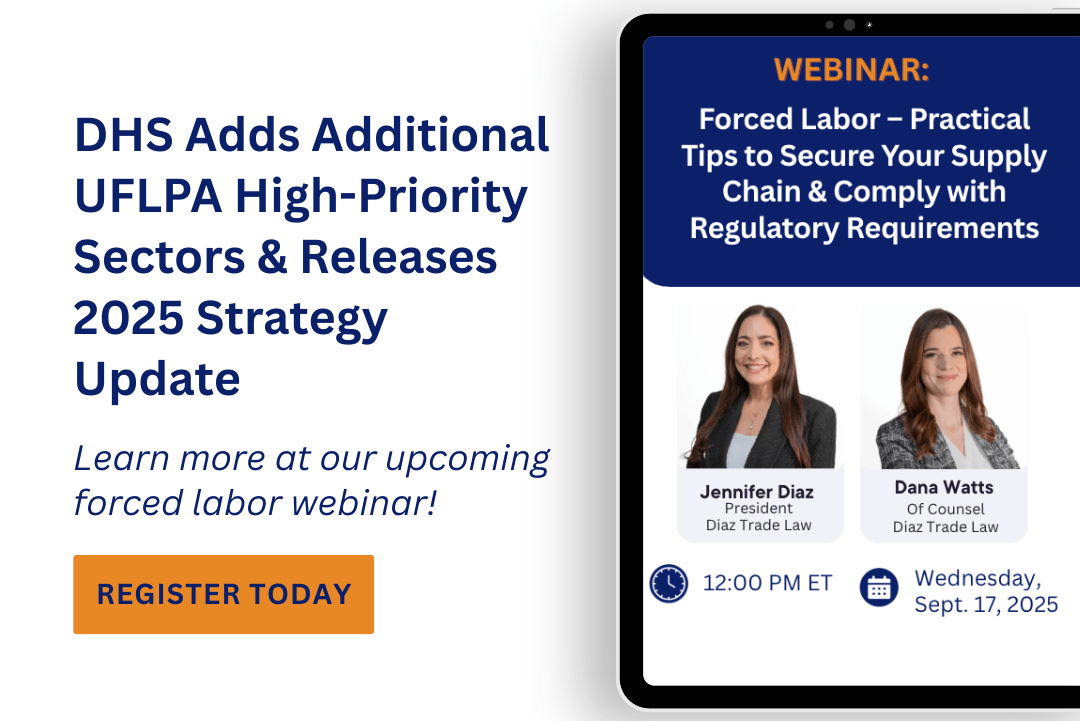
Learn more about this update and all things UFLPA at our upcoming forced labor webinar on Sept. 17, 2025. Register here.

On August 19, 2024, the U.S. Department of Homeland Security (DHS) announced that it would be adding steel, copper, lithium, caustic soda, and red dates to the list of high-priority sectors for enforcement under the Uyghur Forced Labor Prevention Act (UFLPA). DHS also announced the release of an update to the UFLPA enforcement strategy.

Addition of High-Priority Sectors

Under the UFLPA, DHS is tasked with identifying high-priority sectors for enforcement. A high-priority sector designation indicates that entities in the sector have a higher risk of forced labor or state labor transfer of Uyghurs and other ethnic minorities from Xinjiang

In making the announcement of additional sectors, DHS cited each new addition’s connections to forced labor risks. For example, DHS stated that steel and copper have both been government-backed investment focal points in Xinjiang. Similarly, lithium is a government-identified key sector for investment and development in Xinjiang.

UFLPA Enforcement Strategy Update

DHS serves as the chair of the Forced Labor Enforcement Task Force (FLETF). Each year, the task force updates the UFLPA’s Strategy to Prevent the Importation of Goods Mined, Produced, or Manufactured with Forced Labor in the People’s Republic of China (UFLPA Strategy). The task force is statutorily required to provide annual updates […]

Go to Top