Import

New AD Case Filed Against Polytetramethylene Ether Glycol From China, South Korea, Taiwan, and Vietnam   

A new antidumping action has been filed against Polytetramethylene Ether Glycol from China, South Korea, Taiwan, and Vietnam. The allegation is that imports from China, South Korea, Taiwan, and Vietnam are being dumped.  

Full list of exporters here

Import volume here.  

Background on AD Investigations 

Antidumping duty (“AD”) is brought jointly by the U.S. International Trade Commission (“USITC”) and the U.S. Department of Commerce (“Commerce”). AD investigations are triggered when a domestic industry alleges that it has been injured by competing imports of particular goods from specific countries being sold at less than a fair value. The domestic industry initiating the investigation is known as the petitioner, while the foreign industry participating in the investigation is known as the respondent. 

Scope of the Investigation 

The merchandise covered by these investigations is all forms of polytetramethylene ether glycol (“PTMEG”).  

The products subject to the investigation are currently classified in the Harmonized Tariff Schedule of the United States (HTSUS) under the following subheadings: 3907.29.00 and 2932.11.00.   

Full scope here.

Next Steps 

The Commerce Department will determine whether to initiate the investigations within 20 days. The USITC will reach a preliminary determination of material injury or threat of material injury within 45 days. 

As with any proceeding, participation is very important to protect your rights. We urge anyone who imports Polytetramethylene Ether Glycol from China, South Korea, Taiwan, or Vietnam to […]
U.S. Department of Labor Introduces New Tools to Support Supply Chain Integrity and Address Unfair Foreign Labor Practices

On April 8, 2026, the U.S. Department of Labor (DOL) announced the launch of several tools to empower U.S. companies to strengthen their supply chains and defend against unfair competition stemming from overseas labor abuses.

Self-Assessment Tools

DOL launched four voluntary self-assessment tools that provide practical, user-friendly guidance to help companies map supply-chain risks and evaluate labor practices. The tools can also guide companies in taking steps to ensure alignment with U.S. forced labor laws and strengthen supply chains that support American workers and American industry.

The new tools are: 

  • LaborShield: A mobile app that features information on egregious labor violations in over 145 countries (formerly the Sweat and Toil app).
  • ImportWatch: A resource that brings together the department’s labor abuse research with U.S. import data from the U.S. Census Bureau to produce a red-flag list of all high-risk goods for U.S. importers.
  • SourcingStrong: A tool to help U.S. businesses build strong labor due diligence systems to identify and manage risk in their supply chains.
  • Supply Chain Traceability Portal: The portal provides visibility across supply chains and beyond the first tier to expose where exploitative labor hides.

Announcement Insights 

Diaz Trade Law was in attendance at the launch event in Washington, D.C. – hosted by the DOL and […]

New Executive Order Adjusting Imports of Aluminum, Steel, and Copper into the United States

Authors:

Jennifer Diaz, President, Diaz Trade Law
Amber Pirson, Attorney, Diaz Trade Law

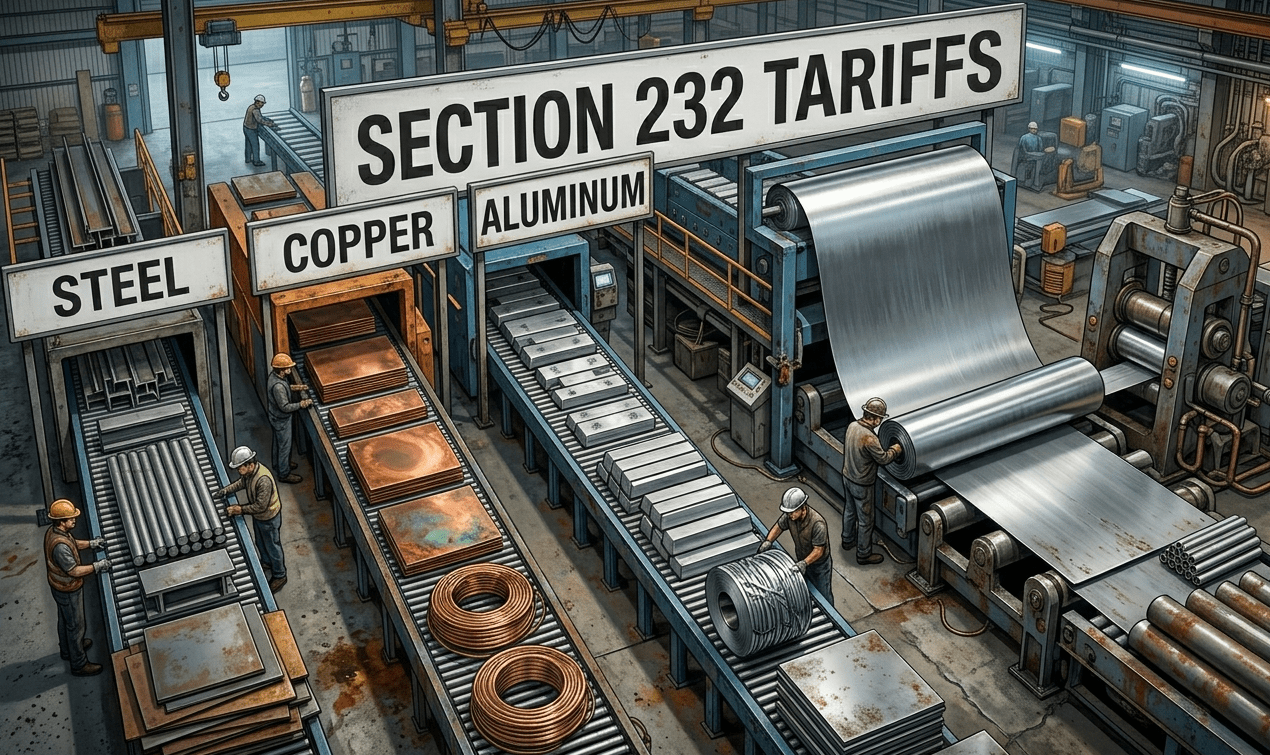
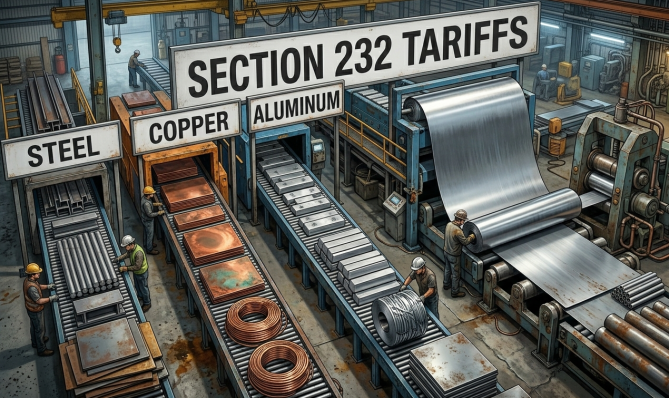
On April 2, 2026, the President issued a proclamation strengthening Section 232 actions to adjust imports of aluminum, steel, and copper, continuing to cite national security concerns and the need to reinforce domestic metals industries. 

Key elements include: a tiered tariff structure and some products exempt from Sec. 232 tariffs, effective at 12:01 am on April 6, 2026; and manufacturing drawback claims.  

Generally, tariffs will be assessed to the full value of imported products, “regardless of their metal content,” with reduced rates for certain products from the United Kingdom (UK) and the same 200% ad valorem duty for subject metal articles from Russia. 

  • Aluminum and steel articles, most copper articles, and certain derivative articles of aluminum and steel…  
    • 50%, unless either the 25% or 10% rates listed below can apply. 
      • 25% for UK products, the aluminum content of which is composed entirely of aluminum that was smelted or most recently cast in the UK, or the steel content of which is composed entirely of steel that was melted and poured in the UK. 
      • 10% for derivative articles, steel or copper content, when the metal content was smelted and cast in the U.S. 
  • For certain copper and […]

Even AI Needs a License – Know When Automation Unlawfully Crosses Into “Customs Business” 

Authors:
Jennifer Diaz, President, Diaz Trade Law
Amber Pirson, Attorney, Diaz Trade Law

In January of this year, CBP quietly released a ruling (January 16, 2026/CEE.HQ H350722) that demarcates clear boundaries of where AI is permitted to facilitate Customs filings and where such artificial tools cross the “human-brokers-only” line.  

Case Background 

A foreign “Unlicensed Company” was operating an online platform and marketing to importers without seeking approval or a license from CBP. This platform offered four key services: 1) connecting importers to brokers, 2) utilizing an optical character recognition (OCR) tool to cull entry data from shipping documents, 3) generating HTSUS subheading suggestions for specific articles, and 4) submitting CBP Form 5106 on behalf of new importers. The question before CBP was whether the company was conducting customs business without a license. 

CBP Ruling 

In its ruling, CBP stated that the definition of “customs business” is quite broad. To that end, developers could accidentally create agentic parameters that trespass the bounds of what it means to engage in “customs business.” Here are some key takeaways from the ruling: 

  1. “CBP cautioned that an unlicensed entity may not serve as an intermediary between a broker and importer if the unlicensed entity is actively participating ‘in decisions and activities relating to the preparation or filing of Customs documents for imported merchandise, or relating to any other action amounting to customs business.’” However, since the “Unlicensed […]
Go to Top