U.S Department of Homeland Security (DHS)

Potential Government Shutdown on the Horizon and No Contingency Plans in Sight

Government funding will lapse at midnight on Tuesday, September 30, absent Congressional action. With a number of contentious issues still at play, including spending limits, immigration policy, and healthcare funding, some say a shutdown is looking more and more likely.

What makes this potential shutdown different from previous lapses in funding is the lack of contingency plans within the relevant agencies. The White House’s Agency Contingency Plan page is blank. 

Until agencies update their guidance, we can only look to previous contingency plans.

Below is a breakdown of previously issued agency guidance. ,

U.S. Customs and Border Protection

According to the Department of Homeland Security’s most recent contingency plan (March 2025) cargo inspection functions at ports of entry will remain active during a shutdown. However, certain activities, such as training and auditing, are not required to be carried out during this time. In addition, back-office support positions are not likely to be deemed essential and will be furloughed. Refunds, audits, ruling requests, etc., would be delayed until the shutdown ends.

There remains uncertainty around which specific offices will be deemed essential. For example, Forced Labor Communications may be furloughed, resulting in delays in reviewing the Enforce and Protect Act (EAPA) and Uyghur Forced Labor Prevention Act (UFLPA) allegations.

U.S. Department of Commerce

According to the Department of Commerce’s most recent contingency plan (September 2023), some International Trade Administration (ITA) […]
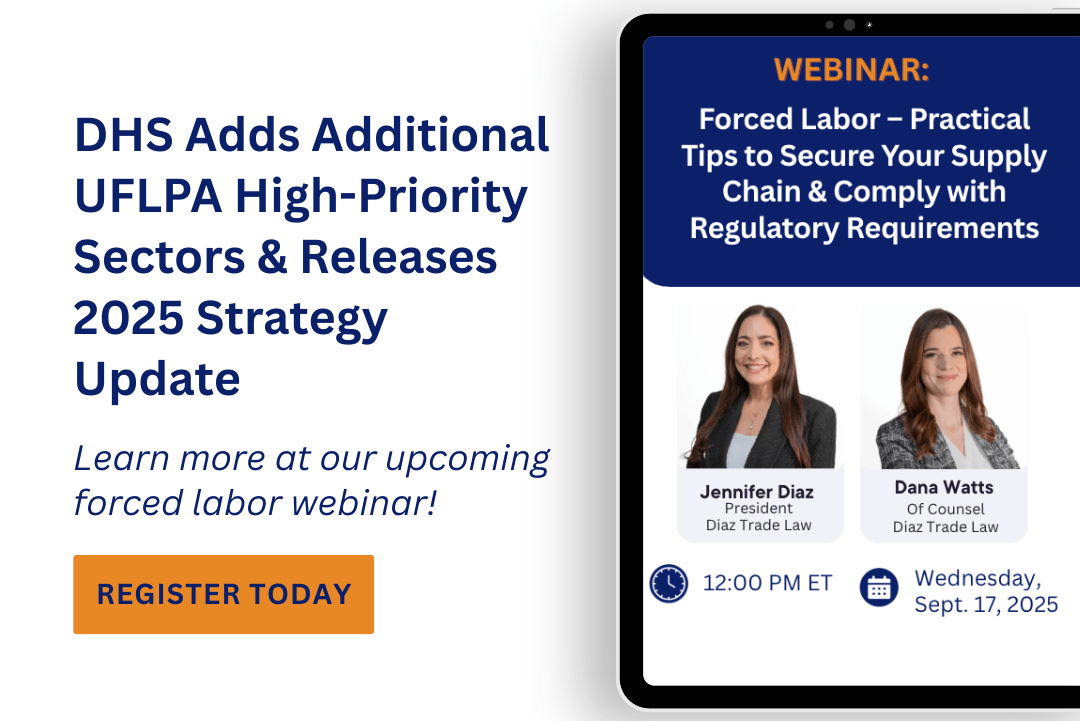
DHS Adds Additional UFLPA High-Priority Sectors; Releases UFLPA 2025 Strategy Update

Learn more about this update and all things UFLPA at our upcoming forced labor webinar on Sept. 17, 2025. Register here.

On August 19, 2024, the U.S. Department of Homeland Security (DHS) announced that it would be adding steel, copper, lithium, caustic soda, and red dates to the list of high-priority sectors for enforcement under the Uyghur Forced Labor Prevention Act (UFLPA). DHS also announced the release of an update to the UFLPA enforcement strategy.

Addition of High-Priority Sectors

Under the UFLPA, DHS is tasked with identifying high-priority sectors for enforcement. A high-priority sector designation indicates that entities in the sector have a higher risk of forced labor or state labor transfer of Uyghurs and other ethnic minorities from Xinjiang

In making the announcement of additional sectors, DHS cited each new addition’s connections to forced labor risks. For example, DHS stated that steel and copper have both been government-backed investment focal points in Xinjiang. Similarly, lithium is a government-identified key sector for investment and development in Xinjiang.

UFLPA Enforcement Strategy Update

DHS serves as the chair of the Forced Labor Enforcement Task Force (FLETF). Each year, the task force updates the UFLPA’s Strategy to Prevent the Importation of Goods Mined, Produced, or Manufactured with Forced Labor in the People’s Republic of China (UFLPA Strategy). The task force is statutorily required to provide annual updates […]

ICYMI: USDA Plan Calls for Stronger Enforcement of Agricultural Imports

On July 8, 2025, the U.S. Department of Agriculture (USDA), along with the Department of Homeland Security (DHS), the Department of Justice (DoJ), and the Department of Defense (DoD), released a National Farm Security Action Plan to elevate American agriculture as a key element of the country’s national security. 

Plan Details

The action plan will enable USDA to work closely with governors, state legislators, and federal partners to further integrate agriculture into the broader national security efforts over the coming months and years.

The USDA and its government partners will take “aggressive action” across seven critical areas:

  1. Secure and Protect American Farmland – Address U.S. foreign farmland ownership from adversaries head-on. Total transparency. Tougher penalties.
  2. Enhance Agricultural Supply Chain Resilience – Refocus domestic investment into key manufacturing sectors and identify non-adversarial partners to work with when domestic production is not available. Plan for contingencies.
  3. Protect U.S. Nutrition Safety Net from Fraud and Foreign Exploitation – Billions have been stolen by foreign crime rings. That ends now.
  4. Defend Agricultural Research and Innovation – No more sweetheart deals or secret pacts with hostile nations. American ideas stay in America.
  5. Put America First in Every USDA Program – From farm loans to food safety, every program will reflect the America […]

DHS Announces New High Priority Sectors for UFLPA Enforcement

The Department of Homeland Security’s (DHS) Forced Labor Enforcement Task Force (FLETF) released an update to the Strategy to Prevent the Importation of Goods Mined, Produced, or Manufactured with Forced Labor in the People’s Republic of China.

Strategy Background

DHS released the first publication of the UFLPA Strategy in June 2022. The strategy outlines a multi-pronged approach to combating forced labor in global supply chains.The strategy includes a comprehensive assessment of the risk of importing goods with forced labor in the PRC, high priority sectors for enforcement, guidance to importers, recommendations to accurately identify affected goods, and more. DHS released the first update to the publication in August of 2023.

The Latest Update  

The update builds on two years of the Administration’s enforcement of the UFLPA. The latest strategy identified new high priority sectors for enforcement – aluminum, polyvinyl chloride (PVC), and seafood. These industries were identified due to higher risk of forced labor or state labor transfer of Uyghurs and other ethnic minorities from the Xinjiang Uyghur Autonomous Region (XUAR).

Entities in these sectors will now be prioritized for review for enforcement actions such as inclusion on the UFLPA Entity List, sanctions, export limitations, and visa restrictions.

Other products previously identified as high priority such as apparel, cotton and cotton products, silica-based products including polysilicon, and tomatoes remain high priority sectors.

The latest updates also outline how the FLETF has significantly advanced their objectives through several initiatives, such as strong enforcement by U.S. Customs and Border Protection (CBP); expansion of the UFLPA Entity List; […]

CBP Publishes Additional Guidance On Responding to Cargo Detentions Made Under the Uyghur Forced Labor Prevention Act

Background

The Uyghur Forced Labor Prevention Act (“UFLPA”) went into effect on June 21, 2022. The law creates a rebuttable presumption that imports of all goods mined, produced, or manufactured wholly or in part in the Xinjiang Uyghur Autonomous Region of China (“Xinjiang”), or by entities identified on the UFLPA Entity List, were made using forced labor and are prohibited from entry into the U.S. under 19 U.S.C. § 1307. For more information about the UFLPA, please see our previous blog articles here and here. U.S. Customs and Border Protection (“CBP”) has been vigorously enforcing this law, detaining hundreds of attempted import shipments every month under both the UFLPA and Withhold Release Orders for suspected forced labor violations.

Importers that have a shipment detained under the UFLPA can seek to have the shipment released under one of two paths. They can either:

  • show that in spite of the fact that the goods were produced wholly or partially in Xinjiang or by an entity on the UFLPA Entity List, they were not in fact made using forced labor; or
  • show that neither the goods nor the inputs used to make the goods were produced wholly or partially in Xinjiang and have no connection to entities on the UFLPA Entity List (i.e., that the goods fall outside the scope of the UFLPA).

Taking the second path means requesting an “admissibility review.”

Last year, pursuant to the UFLPA, the Department of Homeland Security published a Strategy to Prevent the Importation of Goods Mined, […]

Go to Top