U.S. Bureau of Industry and Security (BIS)

You’ve Been Asked to Boycott – What to Know Before You Self‑Disclose

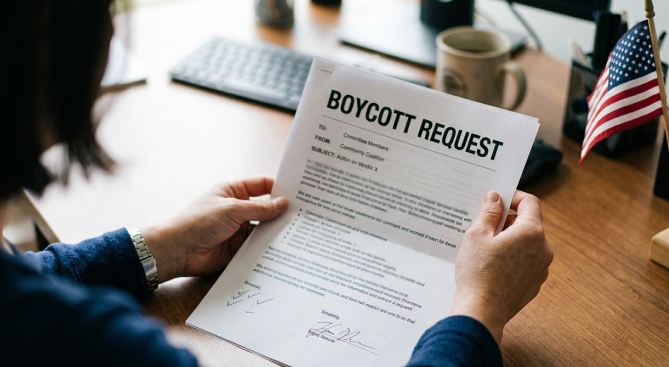
Companies engaged in international trade occasionally encounter requests that raise red flags under the U.S. anti‑boycott regulations. Whether the request appears in a tender document, a purchase order, a letter of credit, oral agreement, verbal request to furnish particular information, or a casual email, the moment you spot boycott‑related language, and become aware that your organization has complied with the request, the clock starts ticking to self-disclose to the Office of Antiboycott Compliance (OAC)
2025 and Beyond: BIS Updates Boycott Requester List

On April 3, 2025, the U.S. Department of Commerce’s Bureau of Industry and Security (BIS) published an updated list of foreign companies that have made boycott-related requests, including requests to comply with the Arab League boycott of Israel. In addition to removing 18 entities who have certified that they have ceased making such prohibited requests, BIS added 30 parties to its list (outlined below). Majority of the newly listed entities are domiciled in Malaysia, which aligns with the country’s foreign policy position that it refuses diplomatic and economic relations with Israel. While companies generally want to comply with the laws of every jurisdiction in which they operate, it is important to understand the risks of non-compliance with OAC rules.  

As recommended by BIS, U.S. companies are encouraged to diligently review transaction documents from all sources, especially those involving these listed parties, to identify possible boycott-related language and to determine whether their recipients have a reporting requirement to BIS.   

If you are unsure whether the language of your contracts must be reported to the OAC or concerned about doing business in jurisdictions where listed entities have been identified, contact Diaz Trade Law today at info@diaztradelaw.com or 305-456-3830.  

Want more information on OAC compliance? Read more here. 

ICYMI: Tri-Seal Advisory: Sanctions and Export Controls Relief for Syria

On November 7, 2025, the Office of Foreign Assets Control (OFAC), alongside the U.S. Department of State and the U.S. Department of Commerce, issued a Tri-Seal Advisory: Sanctions and Export Controls Relief for Syria

The Advisory follows President Trump’s Executive Order on June 30, 2025, formally removing U.S. sanctions on Syria and directing agencies to take additional measures to encourage U.S. private sector and foreign partner reengagement in Syria.

New Opportunities & Remaining Restrictions

The Advisory outlines what business with Syria is now permissible as well as what restrictions remain.

Permissible Business:

  • The United States no longer imposes comprehensive sanctions on Syria. 
  • The Caesar Act is suspended, except for sanctionable transactions with Russia and Iran.
  • The transfer of most basic civilian use U.S.-origin goods, as well as software and technology, to or within Syria is permitted without a license. 

Remaining Restrictions:

  • Sanctions remain on “the worst of the worst:” Bashar al-Assad and his associates, human rights abusers, drug traffickers, and other destabilizing regional actors.
  • The U.S. Government continues to review Syria’s State Sponsor of Terrorism (SST) designation. 
  • Most Commerce Control List items going to Syria still require a U.S. export license.

What Exporters Should Do

The removal of Syria sanctions and the easing of […]

Tariff Updates: Heavy Trucks, Timber & Lumber, Vessel Fees

Over the past several weeks, there has been a flurry of tariff updates affecting importers across multiple industries. From tariffs on heavy-duty vehicles and timber to 232 exclusions and vessel fees, the trade landscape is moving fast, and staying compliant is more challenging than ever. To help you keep up, we’ve summarized recent key tariff developments you need to know. For a full list of tariffs and trade deals, visit our tracker here.

Heavy-Duty Vehicles and Vehicle Parts

On September 25, 2025, President Trump, via Truth Social, announced his intention to impose a 25% tariff on heavy trucks. On October 17, 2025, he issued a Presidential Proclamation formalizing and clarifying these tariffs. The proclamation imposes a 25% tariff on imports of medium- and heavy-duty trucks and truck parts. This includes Class 3 to Class 8 vehicles, like large pick-up trucks, moving trucks, cargo trucks, dump trucks, and tractors for eighteen-wheelers. 

The Proclamation also imposes a 10% tariff on imports of buses, including school buses, transit buses, and motor coaches. The tariffs are set to take effect on November 1, 2025.

President Trump is imposing the new tariffs under section 232 of the Trade Expansion Act of 1962, citing national security concerns.

If medium and heavy-duty vehicles qualify for USMCA treatment, the importer may submit documentation to identify the amount of U.S. content, and, after the Department of Commerce’s […]

ICYMI: BIS Imposes New Affiliates Rule

[Update November 10, 2025]: BIS imposed a one-year suspension of the interim final rule. The suspension is set to end November 9, 2026, absent a future extension.

On September 30, 2025, the Bureau of Industry and Security (BIS) released an interim rule regarding “Affiliates.” Under the rule, any entity that is at least 50% owned by one or more entities on the Entity List or the Military End-User (MEU) List will itself automatically be subject to Entity List/MEU restrictions. This is a significant change from the current standard, which excludes entities that are not specifically included on the Entity List or MEU List, regardless of any affiliation with Entity List or MEU List organizations. 

This rule is effective September 29, 2025.

Entity, MEU List Background

The Entity List identifies persons (including businesses, research institutions, government and private organizations, individuals, and other types of legal persons) reasonably believed to be involved, or to pose a significant risk of being or becoming involved, in activities contrary to the national security or foreign policy interests of the United States. These persons are subject to specific license requirements for the export, reexport, and/or transfer (in-country) of specified items.  

BIS first published the Entity List in 1997. Since its initial publication, grounds for inclusion on the Entity List have expanded to activities sanctioned by the State Department and activities contrary to U.S. […]

Go to Top