
High Tariffs, High Stakes: The Rise in Customs Fraud and Enforcement Risk

As tariffs climb and global trade grows more complex, a growing number of importers are testing the limits, or outright breaking the law, to reduce or avoid duty payments. U.S. enforcement agencies, including Customs and Border Protection (CBP) and the Department of Justice (DOJ), have made it clear that customs fraud will not be tolerated and is a top enforcement priority. 

High Tariffs = High Incentive to Cheat

High tariffs create an incentive to cheat. Whether it’s through misclassifying goods, undervaluing imports, or using deceptive transshipment routes, some companies are turning to creative or outright illegal strategies to reduce their tariff liability.

This is not theoretical, we’ve seen it before. During the U.S.–China trade war of 2018–2019, there was a surge in country-of-origin fraud, particularly Chinese goods re-labeled as “Made in Vietnam.” Known as a “country of origin wash,” this practice misleads CBP and avoids duties tied to China. 

These incentives have contributed to the emergence of a cottage industry of “tariff reduction” companies that advertise ways to cut import costs. However, many of these so-called strategies amount to evasion, putting importers at serious legal risk.

DOJ Prioritizes Customs Fraud

The Department of Justice is watching closely. In a May 2025 memo, Matthew Galeotti, head of the DOJ’s Criminal Division, named trade and customs fraud as one of the top enforcement priorities in white-collar crime.

The DOJ also expanded its Corporate Whistleblower Awards Pilot Program […]
Customs Bulletin Update – Vol. 56, October 19, 2022, No. 41

Below is a recap for last week’s Custom’s Bulletin.

  • Revocation of three ruling letters, modification of one ruling letter, and revocation of treatment relating to the tariff classification of certain step stools
    • Pursuant to 19 U.S.C. § 1625(c)(1), CBP is revoking NY N294603, dated March 2, 2018, NY N196451, dated December 27, 2011, NY M84487, dated June 27, 2006, and modifying NY N235681, dated December 5, 2012, and revoking or modifying any other ruling not specifically identified to reflect the analysis contained in HQ H305377, set forth as an Attachment to this notice. Additionally, pursuant to 19 U.S.C. § 1625(c)(2), CBP is revoking any treatment previously accorded by CBP to substantially identical transactions.
    • It is now CBP’s position that a one-step step stool is classified according to its constituent material in heading 3924, if made of plastics or in heading 4421, if made of wood. Accordingly, pursuant to GRI’s 1 and 6, the plastic one-step step stools in NY N294603 and NY N196451 are classified in subheading 3924.90.56, which provides for “Tableware, kitchenware, other household articles and hygienic or toilet articles, of plastics: Other: Other”. The one-step step stool made of MDF in NY N235681 and the wooden step stool in NY M84487 are classified in subheading 4421.99.97, which provides for “Other articles of wood: Other: Other: Other: Other
  • Proposed modification of one ruling letter and proposed revocation of treatment relating to the tariff classification of paper face masks
    • Pursuant to 19 U.S.C. § 1625(c)(1), CBP is proposing to […]

Customs and Trade Law Weekly Snapshot

Here is a recap of the latest customs and international trade law news:


[…]

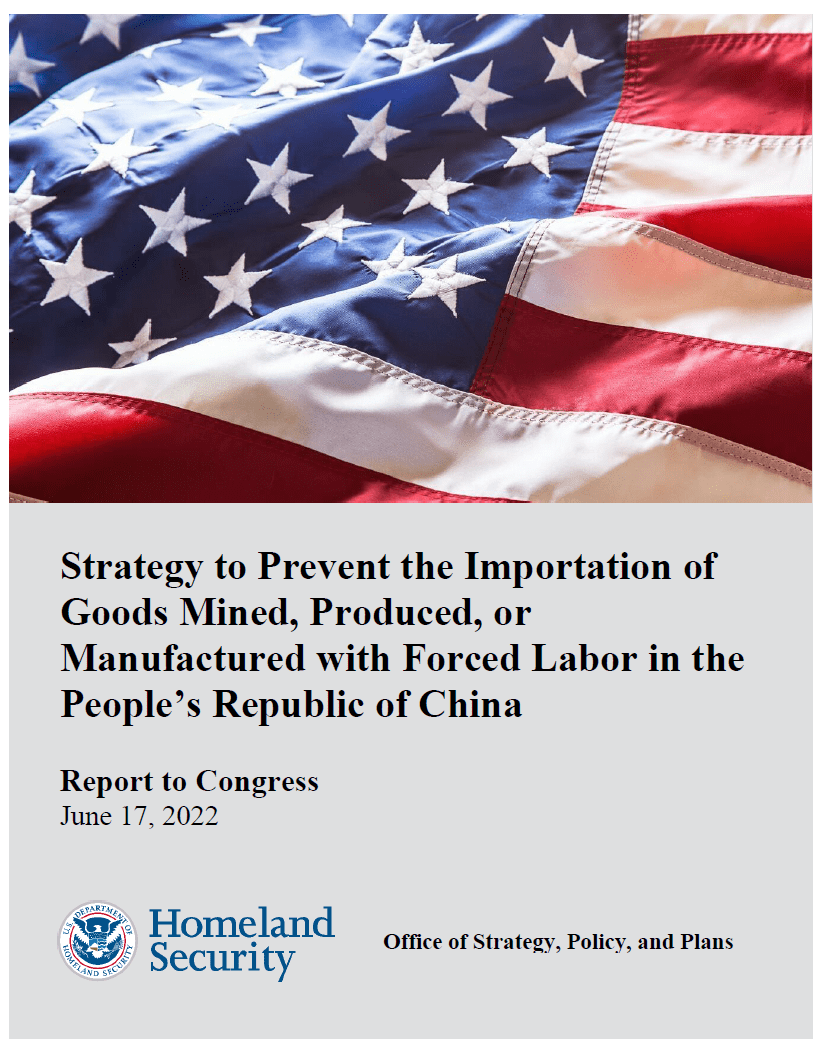
UFLPA DHS Forced Labor Guidance – What Importers Need to Know

On June 17,  2022, DHS published its long-awaited strategy guidance document which shed light on how UFLPA will be implemented, and what evidence may be provided to rebut the presumption that the goods were made with forced labor. This article provides an overview of the type of evidence importers should have readily available when importing goods into the United States. For general guidance on preventing the importation of goods produced with forced labor and how importers should audit their supply chain to ensure non-use of forced labor, please refer to our Bloomberg Law article, “U.S. Customs Targets Use of Forced Labor”.

UFLPA

The Uyghur Forced Labor Prevention Act (UFLPA) establishes a rebuttable presumption that goods mined, produced, or manufactured wholly or in part in the Xinjiang Province of China or by an entity on the UFLPA Entity List are prohibited from importation into the United States under 19 U.S.C. § 1307. However, if an Importer of Record can demonstrate by clear and convincing evidence that the goods in question were not produced wholly or in part by forced labor, fully respond to all CBP requests for information about goods under CBP review and demonstrate that it has fully complied with the guidance outlined in this strategy, the Commissioner of CBP may grant an exception to the presumption.

Clear and convincing evidence is a higher standard of proof than a preponderance of the evidence, and generally means that a claim or […]

Big News! 352 of 549 Proposed China Tariff Exclusions Reinstated

On March 23, 2022, the U.S. Trade Representative (“USTR”) announced that 352 of the 549 proposed exclusions have been reinstated. The reinstated product exclusions will apply as of October 12, 2021, and extend through December 31, 2022. For a full list of reinstated exclusions, please see this Federal Register announcement.

On October 8, 2021, USTR invited comments on whether to reinstate 549 previously granted and extended exclusions. This recent determination was a result of USTR’s review of public comments regarding whether and which of the proposed exclusions should be reinstated.

Diaz Trade Law filed comments on behalf of several clients who have had their exclusions reinstated. Are your products on the list of exclusions that were reinstated? Do you have questions about navigating Section 301 China tariffs? We are here for you! Diaz Trade Law has significant experience working on Section 301 exclusions. Contact us today at info@diaztradelaw.com.

A list of all the exclusions can be found below:

A. Effective with respect to good entered for consumption, or withdrawn from warehouse for
consumption, on or after 12:01 a.m. eastern daylight time on October 12, 2021, and before
11:59 p.m. eastern daylight time on December 31, 2022, subchapter III of chapter 99 of the
Harmonized Tariff Schedule of the United States (HTSUS) is modified:
1. by inserting the following new heading 9903.88.67 in numerical sequence, with the
material in the new heading inserted in the columns of the HTSUS labeled
“Heading/Subheading”, “Article Description”, and “Rates of Duty 1-General”,
respectively:
Heading/Subheading: 9903.88.67

Article Description: Effective with respect to entries on or after
October 12, […]

Go to Top