November 2025

Jewelry Company Charged in $86M Duty Evasion Scheme

On November 17, 2025, the owner of an Indonesian jewelry company (USB Gold) and two employees were charged with taking part in a scheme to evade over $86 million in duties on jewelry imports. 

The employees were arrested and charged with one count of conspiracy to commit wire fraud and were detained. The company co-owner, who was also charged, remains in Indonesia and has not yet been arrested.

The defendants allegedly engaged in a complex scheme to import over $1.2 billion of jewelry and illegally defraud the United States out of more than $86 million in customs duties and tariffs. 

The alleged scheme included two parts:

  • First, UBS Gold made jewelry in Indonesia and shipped it to Jordan, which had a Free Trade Agreement with the United States, before sending it to the United States. The defendants then falsely claimed that UBS Gold jewelry had been manufactured in Jordan, which avoided the duty that would otherwise apply.
  • Second, when the U.S. announced additional tariffs on Indonesia and Jordan earlier this year, the company began shipping scrap gold from the U.S. to Jordan, which they falsely claimed was gold jewelry that simply needed to be assembled or finished in Jordan. Instead, the defendants and co-conspirators swapped the scrap gold for UBS Gold jewelry made in Indonesia, which they then shipped from Jordan to the U.S. The […]
ICYMI: Tri-Seal Advisory: Sanctions and Export Controls Relief for Syria

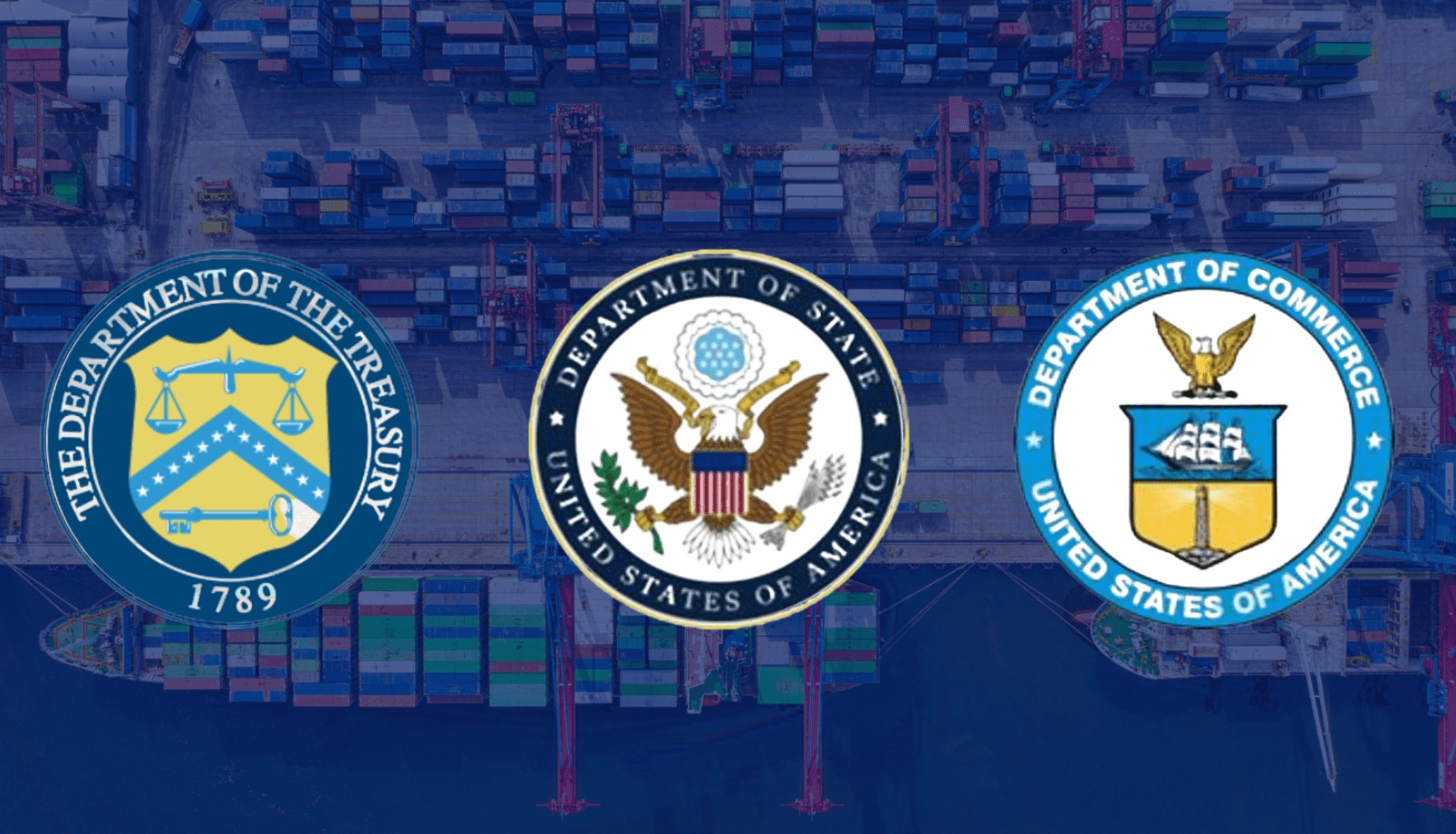
On November 7, 2025, the Office of Foreign Assets Control (OFAC), alongside the U.S. Department of State and the U.S. Department of Commerce, issued a Tri-Seal Advisory: Sanctions and Export Controls Relief for Syria

The Advisory follows President Trump’s Executive Order on June 30, 2025, formally removing U.S. sanctions on Syria and directing agencies to take additional measures to encourage U.S. private sector and foreign partner reengagement in Syria.

New Opportunities & Remaining Restrictions

The Advisory outlines what business with Syria is now permissible as well as what restrictions remain.

Permissible Business:

  • The United States no longer imposes comprehensive sanctions on Syria. 
  • The Caesar Act is suspended, except for sanctionable transactions with Russia and Iran.
  • The transfer of most basic civilian use U.S.-origin goods, as well as software and technology, to or within Syria is permitted without a license. 

Remaining Restrictions:

  • Sanctions remain on “the worst of the worst:” Bashar al-Assad and his associates, human rights abusers, drug traffickers, and other destabilizing regional actors.
  • The U.S. Government continues to review Syria’s State Sponsor of Terrorism (SST) designation. 
  • Most Commerce Control List items going to Syria still require a U.S. export license.

What Exporters Should Do

The removal of Syria sanctions and the easing of […]

New AD/CVD Case Filed Against Van-Type Trailers and Subassemblies Thereof From Canada, Mexico, and China 

A new antidumping and countervailing duty action has been filed against Van-Type Trailers and Subassemblies Thereof From Canada, Mexico, and the People’s Republic of China (China). The allegation is that imports from Canada, Mexico, and China are unfairly subsidized and being dumped.  

Full list of exporters here. 

Full list of importers here 

Background on AD/CVD Investigations 

Antidumping duty (“AD”) and countervailing duty (“CVD”) investigations are brought jointly by the U.S. International Trade Commission (“USITC”) and the U.S. Department of Commerce (“Commerce”). AD investigations are triggered when a domestic industry alleges that it has been injured by competing imports of particular goods from specific countries being sold at less than a fair value. Meanwhile, CVD investigations are triggered when a domestic industry alleges that it has been injured by competing imports that are being unfairly subsidized by their governments. The domestic industry initiating the investigation is known as the petitioner while the foreign industry participating in the investigation is known as the respondent. 

Scope of the Investigation 

The merchandise covered by these investigations is van-type trailers and subassemblies thereof, whether finished or unfinished.  

The products subject to the investigation are currently classified in the Harmonized Tariff Schedule of the United States (HTSUS) under the following subheadings: 8716.39.0040, 8716.90.5060, 7308.30.5050, 7308.90.9590, 7326.90.8688, 8708.29.1500, 9708.99.8180, and 8716.90.5010.  

Full scope here.

Next Steps 

The Commerce Department will determine whether to initiate the investigations […]

By |2025-11-24T09:29:38-05:00November 24, 2025|AD/CVD, U.S. Department of Commerce (DOC)|0 Comments

Breaking Trade News: New WRO Order, Brazil Tariffs Reduced, $86M Evasion Scheme

Here is a recap of the latest customs and international trade news: 

Customs and Border Protection (CBP) 

  • CBP issued a withhold release order against imports manufactured in Mauritius by Firemount Group. Effective November 18, CBP will immediately detain all garments, apparel, and textiles coming from Firemount factories in Mauritius. 
  • CBP is accepting applications through December 19 for members of the Commercial Customs Operations Advisory Committee (COAC).  
  • CBP completed a training with True Pedigree, a software provider specializing in detecting counterfeits and gray market diversions. True Pedigree’s AGMA One Device aims to help CBP officers with authenticating products entering the U.S. The tool could be rolled out at U.S. ports early next year. 
  • Management of CBP’s drawback program, as well as its drawback specialists, has been moved to the Petroleum, Natural Gas, and Mineral Center of Excellence and Expertise in Houston.  
  • CBP is urging customs brokers who filed entries after tariff exemptions on agricultural products retroactively took effect to file corrections as soon as possible.  
  • CBP published a Federal Register notice amending its regulations for the Air Cargo Advanced Screening program (ACAS). The new regulations require additional data […]
By |2025-11-21T08:23:50-05:00November 21, 2025|news, Snapshot, Uncategorized|0 Comments

Act NOW to Preserve Potential Tariff Refunds

Tariff policy is changing overnight, and all indicators signal that the Trump Administration will continue to impose tariffs to achieve its trade agenda. There are several lawsuits pending that may eventually invalidate some of the Administration’s tariffs. However, importers should not sit around and wait for the dust to settle. Importers must act NOW and take proactive measures to protect their ability to seek refunds if tariffs are ultimately found to be unlawful. 

IEEPA Tariffs at the Supreme Court

The Supreme Court (SCOTUS) heard oral arguments in Learning Resources, Inc. v. Trump on November 5, 2025. The case challenges whether the President has the authority to impose tariffs under the International Emergency Economic Powers Act (IEEPA). The Administration relied heavily on IEEPA to impose new tariffs – including fentanyl tariffs on China, Canada, and Mexico, and global reciprocal tariffs. Many trade lawyers are predicting that the Court will rule in favor of importers and find that IEEPA does not grant the President the authority to impose sweeping tariffs. 

Potential Refunds & What Importers Should Do

Although it remains unclear how CBP will handle refunds (should SCOTUS agree with the lower courts), it is likely that once an entry is liquidated and the liquidation becomes final, CBP may not grant a refund of duties paid, regardless of SCOTUS’s outcome. It will likely be the position that CBP only has to grant refunds to those parties that have a Court […]

By |2025-11-17T09:01:16-05:00November 17, 2025|International Trade, Pre-compliance, tariffs|0 Comments
Go to Top