Supply Chain

De Minimis No More: What it Means for Importers and Consumers

President Trump’s Executive Order suspending duty-free de minimis treatment of shipments entering the U.S. took effect last week. The de minimis exemption has been used by retailers around the world catering to the American shopper, and the end of the policy is causing a ripple effect around the globe.

What is De Minimis?

De minimis is a Latin term that means “of the smallest things,” “trifling,” “insignificant.” In the U.S., the de minimis rule dates back to the Tariff Act of 1930. Upon passage of the act, individuals and businesses were permitted to import shipments under $200 without paying duties and taxes. 

The intent behind the exemption was to allow CBP to focus on higher-risk and higher-revenue imports and to encourage small-scale trade. In 2016, the U.S. raised the de minimis threshold to $800 with the passage of the Trade Facilitation and Trade Enforcement Act

After the 2016 change, de minimis shipments surged, from 139 million in FY 2015 to 1.36 billion in FY 2024. International retailers took advantage of the new threshold, and many U.S. policymakers began referring to de minimis as a “loophole.” 

Citing safety and fairness concerns, there were dozens of unsuccessful efforts in the U.S. Congress to end de minimis. Finally, the Big Beautiful Bill of 2025
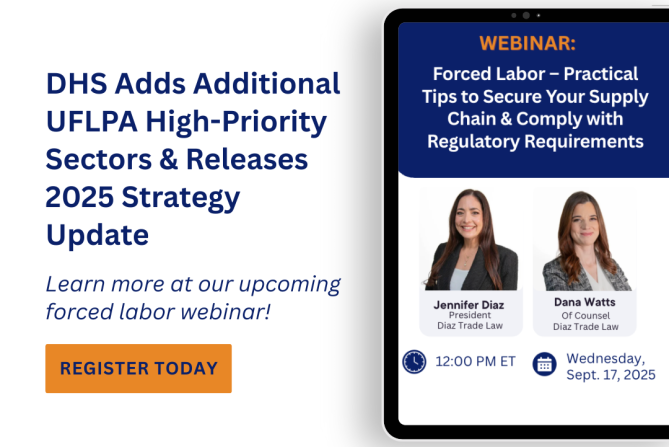
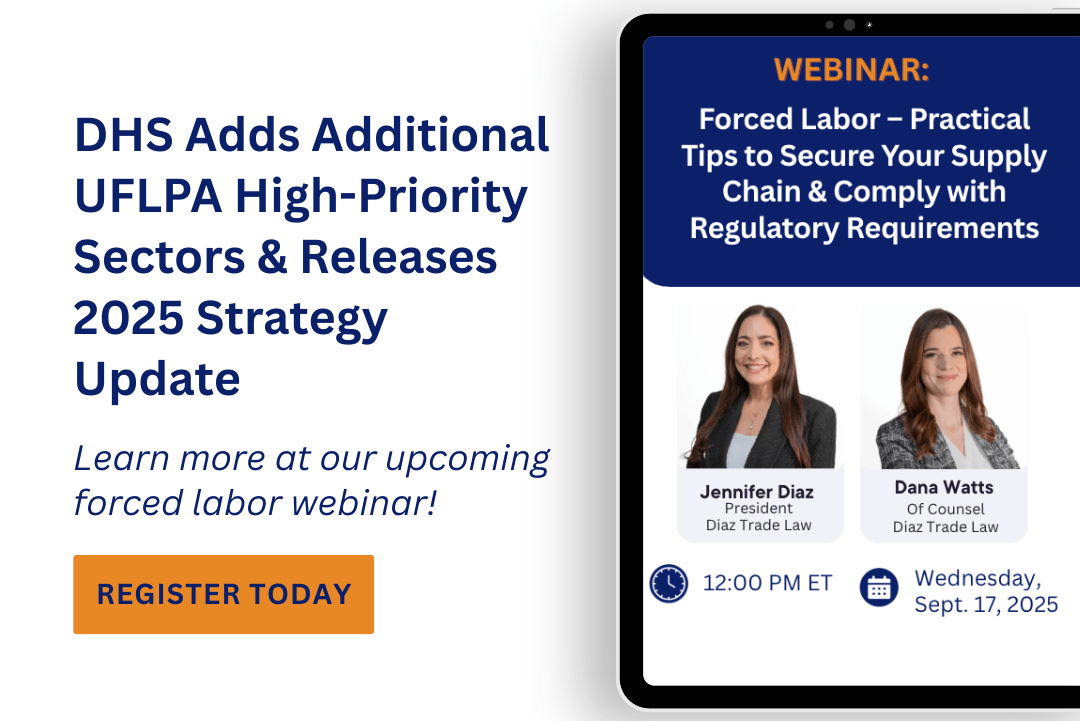
DHS Adds Additional UFLPA High-Priority Sectors; Releases UFLPA 2025 Strategy Update

Learn more about this update and all things UFLPA at our upcoming forced labor webinar on Sept. 17, 2025. Register here.

On August 19, 2024, the U.S. Department of Homeland Security (DHS) announced that it would be adding steel, copper, lithium, caustic soda, and red dates to the list of high-priority sectors for enforcement under the Uyghur Forced Labor Prevention Act (UFLPA). DHS also announced the release of an update to the UFLPA enforcement strategy.

Addition of High-Priority Sectors

Under the UFLPA, DHS is tasked with identifying high-priority sectors for enforcement. A high-priority sector designation indicates that entities in the sector have a higher risk of forced labor or state labor transfer of Uyghurs and other ethnic minorities from Xinjiang

In making the announcement of additional sectors, DHS cited each new addition’s connections to forced labor risks. For example, DHS stated that steel and copper have both been government-backed investment focal points in Xinjiang. Similarly, lithium is a government-identified key sector for investment and development in Xinjiang.

UFLPA Enforcement Strategy Update

DHS serves as the chair of the Forced Labor Enforcement Task Force (FLETF). Each year, the task force updates the UFLPA’s Strategy to Prevent the Importation of Goods Mined, Produced, or Manufactured with Forced Labor in the People’s Republic of China (UFLPA Strategy). The task force is statutorily required to provide annual updates […]

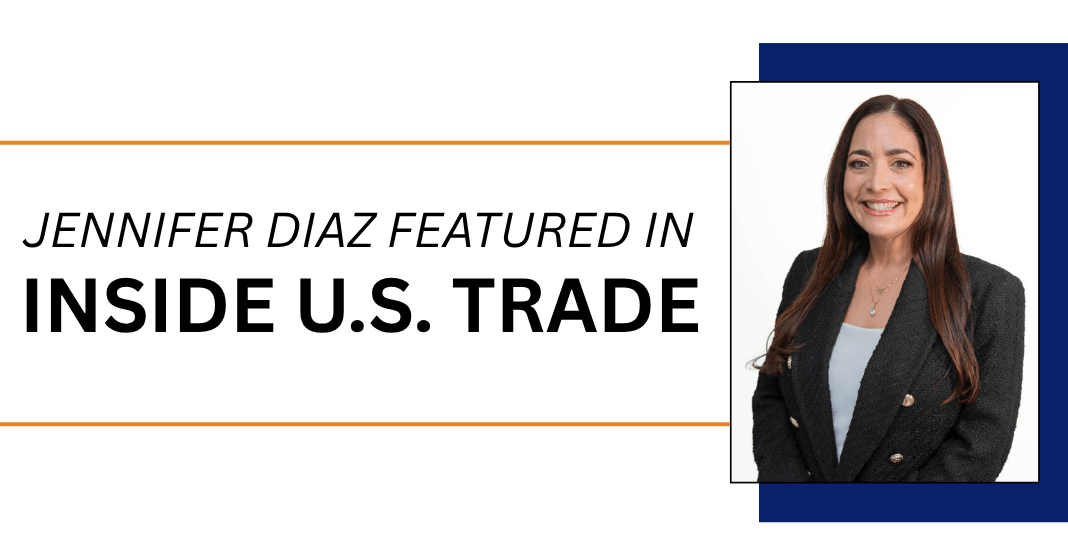
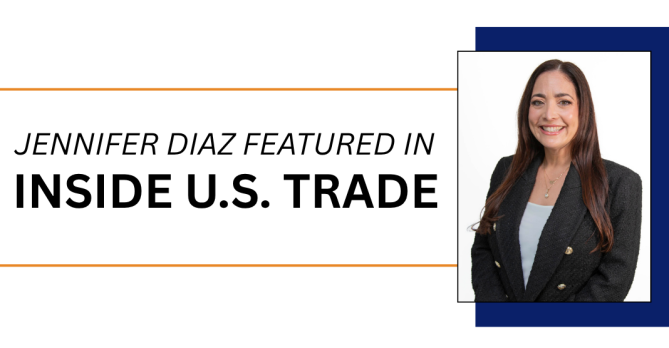
Jennifer Diaz Featured in Inside U.S. Trade

We are pleased to announce that DTL President Jennifer Diaz was recently featured in Inside U.S. Trade!

In the article, “New Transshipment Limits Could Bring Confusion, Enforcement Hurdles,” reporter Brett Fortnam walks through how the Administration’s new approach to combatting transshipment includes goods with significant content from third countries in addition to traditional transshipment. He quoted Jennifer on how this approach is likely to cause confusion up and down the supply chain.

Below are a few snippets from the piece. Read the full article on InsideTrade.com here.

“Diaz said a new approach to transshipment will sow confusion up and down the supply chain. Changing what confers a product’s country of origin ‘adds another pillar of complexity’ to already complicated rules of origin, Diaz said.”

“If I were CBP, I would have a hard time understanding what kind of documentation and proof will be necessary,” Diaz said of the new policy. “Are we going to have the ability to audit raw material for every item? We all need a framework to start with. Now we’re all subject to audit risk, penalties and criminality. We need a good framework to ensure that everyone has the ability to comply.”

Diaz Trade Law is tracking the latest updates to U.S. trade policy.

Learn more:

By |2025-08-05T13:34:46-04:00August 5, 2025|Import, news, Supply Chain|0 Comments

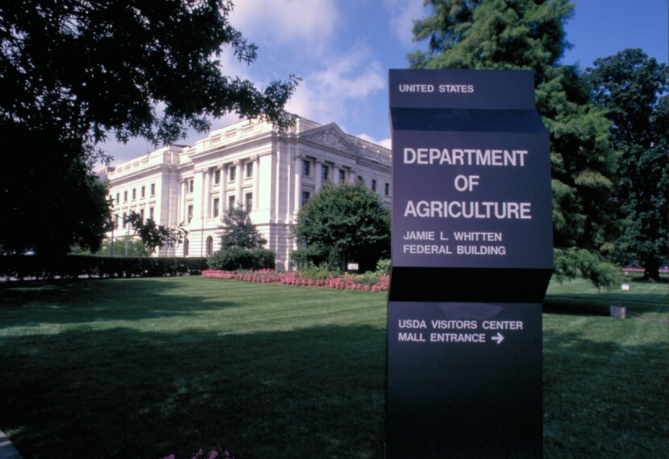
ICYMI: USDA Plan Calls for Stronger Enforcement of Agricultural Imports

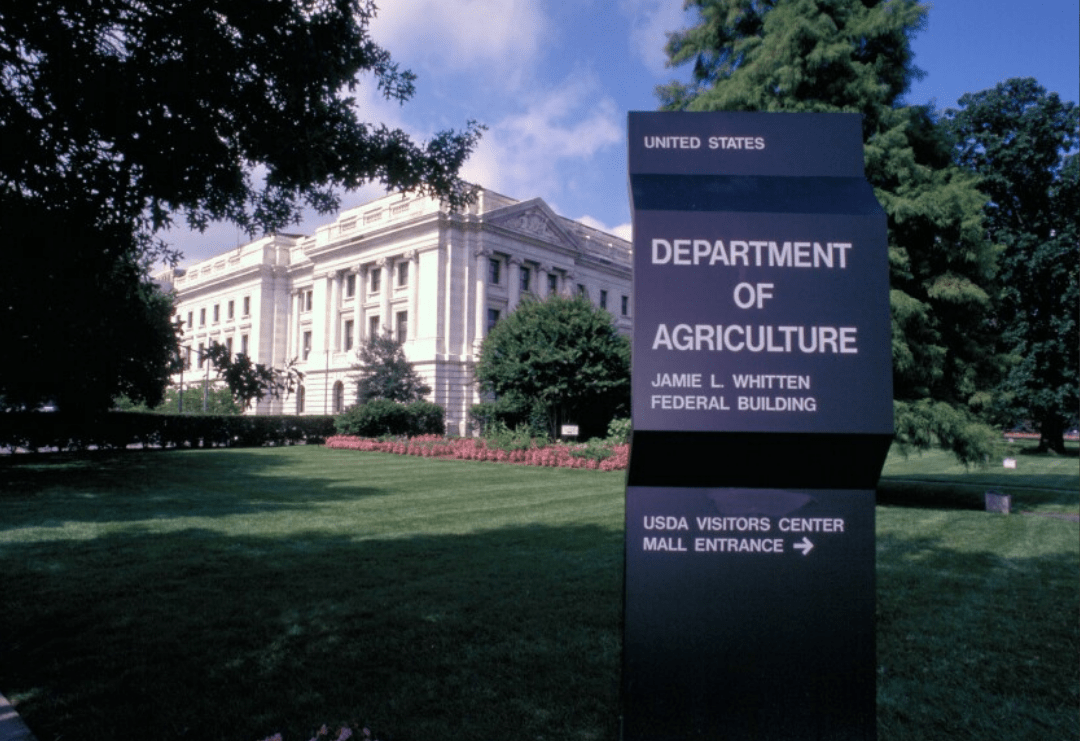
On July 8, 2025, the U.S. Department of Agriculture (USDA), along with the Department of Homeland Security (DHS), the Department of Justice (DoJ), and the Department of Defense (DoD), released a National Farm Security Action Plan to elevate American agriculture as a key element of the country’s national security. 

Plan Details

The action plan will enable USDA to work closely with governors, state legislators, and federal partners to further integrate agriculture into the broader national security efforts over the coming months and years.

The USDA and its government partners will take “aggressive action” across seven critical areas:

  1. Secure and Protect American Farmland – Address U.S. foreign farmland ownership from adversaries head-on. Total transparency. Tougher penalties.
  2. Enhance Agricultural Supply Chain Resilience – Refocus domestic investment into key manufacturing sectors and identify non-adversarial partners to work with when domestic production is not available. Plan for contingencies.
  3. Protect U.S. Nutrition Safety Net from Fraud and Foreign Exploitation – Billions have been stolen by foreign crime rings. That ends now.
  4. Defend Agricultural Research and Innovation – No more sweetheart deals or secret pacts with hostile nations. American ideas stay in America.
  5. Put America First in Every USDA Program – From farm loans to food safety, every program will reflect the America […]

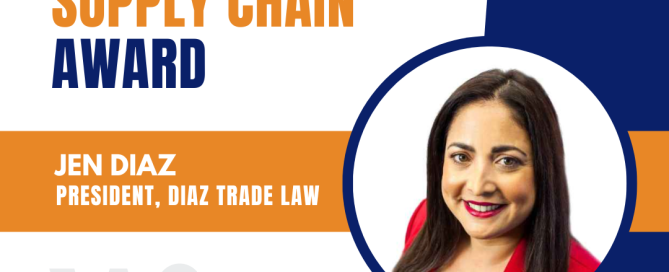
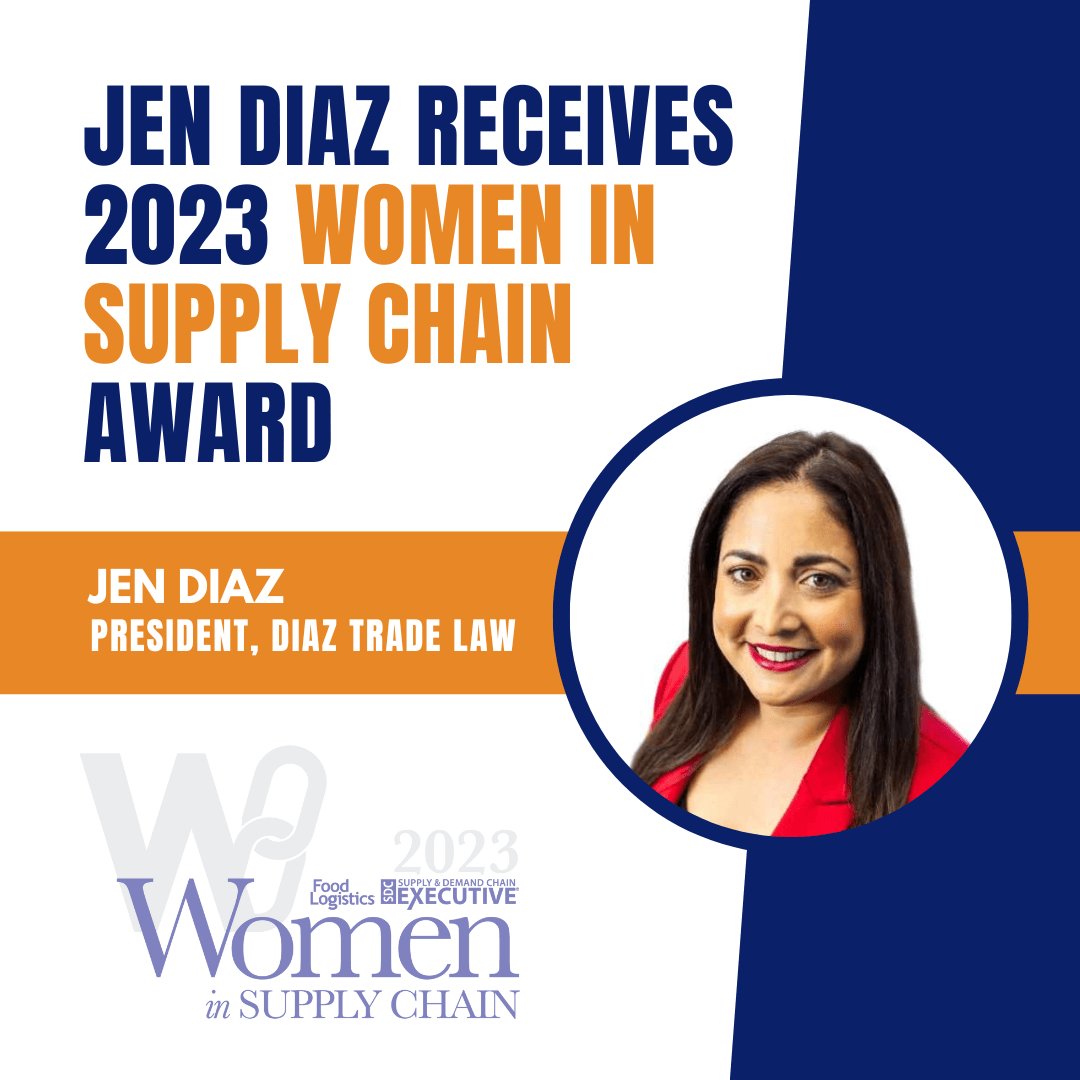
Jennifer Diaz Named Recipient of 2023 Women in Supply Chain Award

This award honors female supply chain leaders and executives whose accomplishments, mentorship and examples set a foundation for women in all levels of a company’s supply chain network.

Food Logistics, the only publication exclusively dedicated to covering the movement of product through the global cold food supply chain, and Supply & Demand Chain Executive, the only publication covering the entire global supply chain, named Jen Diaz as one of the winners of this year’s Women in Supply Chain Award, which honors female supply chain leaders and executives whose accomplishments, mentorship and examples set a foundation for women in all levels of a company’s supply chain network.   

“This year, we received over 400 submissions, the highest amount of applications not only for this award, but also for all of our awards. What’s more, 118 of those applications were submitted by male counterparts, nominating their boss, co-worker or associate. Last year, that figure was just at 75. Also this year, 39 women self-nominated, a tremendous uptick from last year’s award, which just saw 12 self-nominations. This shows progress. This shows hope that one day, we won’t need an award like this because men and women in the supply chain will be equal,” says Marina Mayer, Editor-in-Chief of Food Logistics and Supply & Demand Chain Executive. “While there’s still more work to be […]

By |2023-09-22T11:16:29-04:00September 22, 2023|Supply Chain|0 Comments
Go to Top